

Choosing Your Shoe Size
Choosing the right shoe size is essential to feel comfortable in your shoes! If you don’t know (or no longer know) your shoe size, here are some tips to help you find this valuable information:
- Look at the shoes you are currently wearing! The size is usually hidden under the sole, inside the shoe (on the sides), or on the tongue. Keep in mind that each brand has its own fit, and shoe size equivalencies can vary from one brand to another. More information on this topic here.
- If you have already purchased shoes from La Botte Chantilly, let us know and we can digitally retrieve the size chosen during your purchase.
- If you live in the Hauts-de-France region, visit one of our stores and we will be happy to help you find the perfect pair!
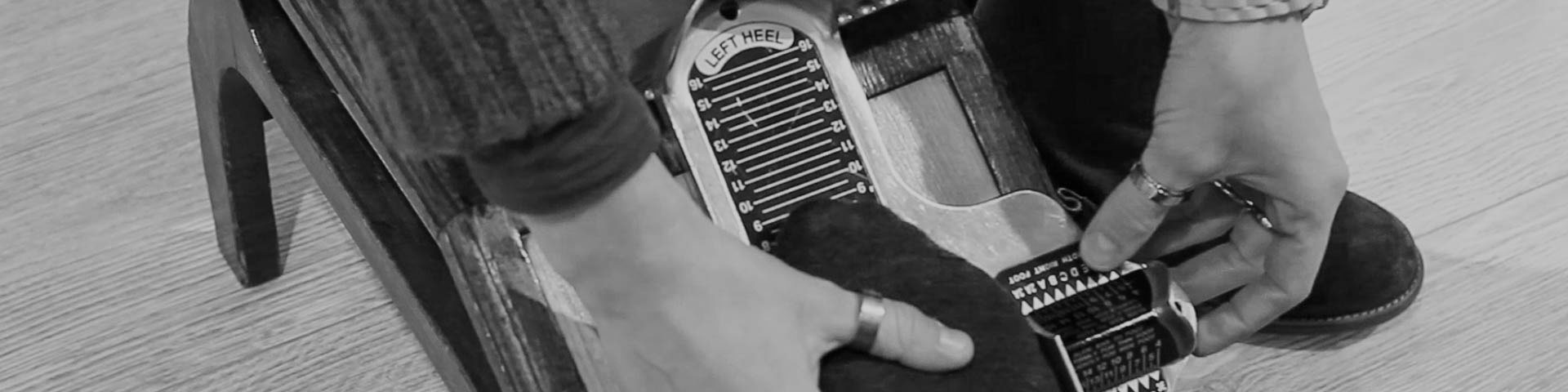
- Measure your foot with a foot measuring device:
Not all shoe brands use the same sizing system. French, American, English, or Italian systems are all different. These are conversions from one size to another. The result is approximate and can vary depending on foot shapes.
Thus, it’s not surprising that a size 41 from one manufacturer might be equivalent to a 43 from another. Some brands like Paul Green, Gabor, or Hogan also use half sizes, which offer a more precise fit, but sometimes also a more vague one to transpose.
Refer to the brands’ shoe size conversion charts when choosing your size.
If in doubt, please contact us by phone at 03 20 55 34 80 or by email at eshop@la-botte.com; we will be happy to assist you!
Once you have determined your shoe size, comes the much-anticipated moment: choosing your shoes. This step is crucial, as you need to consider your foot’s morphology to find shoes in which you will feel comfortable.
For narrow feet, we recommend lace-up ankle boots or sandals with adjustable straps, to properly support the ankle.
For wide feet (high, pronounced instep), we advise avoiding narrow or tapered shoes, which might not leave enough room for your feet or compress your toes.
A new pair might feel stiff at first, but after about ten minutes of wear, the leather warms up, softens, and adapts to the shape of the foot, fitting like a glove!
For an adult, a pair of shoes that is neither too small nor too large should have a minimum of 5 mm and a maximum of 12 mm of ’empty space’ at the front of the shoe. Everything also depends on how you like to wear your shoes, whether looser or tighter.
As with chocolate or skydiving, extremes are never recommended. The same applies to heels. Doctors advise against daily wear of high heels (with an arch greater than 6 cm) as well as completely flat shoes (heels less than 1 cm), at the risk of weakening your joints (back, knees, feet…).
Experts agree that the arch, meaning the main support point of the foot, should be as close as possible to its natural shape.
For high heel enthusiasts, here are some recommendations:
- Choose platform shoes to reduce the actual arch of the pair and protect your joints.
- Opt for wide heels so that your body weight is distributed over the largest possible surface.
- Be sensible and carry a flatter pair of shoes in your bag, just in case…
Sizing children’s shoes is a bit different. The criteria vary depending on the child’s age, motor skills, and foot morphology. Shoes of the correct size are crucial for learning to walk, as well as for the child’s proper posture.
But the most changing factor is growing feet! Don’t panic, we’ll explain everything and even give you some tips to put into practice!
A child’s foot grows relatively quickly. During their first 5 years, they will change shoe size an average of 2 to 3 times a year (sometimes more, sometimes less; there’s no absolute rule, every child is different).
Since a young child rarely complains that their shoes are too small, it’s up to you, the parents, to regularly (every 3 to 4 months) check their shoe size and ensure that the shoes they are wearing are still the correct size.
To do this, have the child stand straight with their feet flat in their shoes. Then slide your index finger between the heel and the counter (back part) of their shoe. If your finger doesn’t fit, the shoe is too small.
If the shoe’s insole is removable, take it out and have the child stand on it, as if it were a foot measuring device. Make sure the heel is well placed at the back edge of the insole, without extending beyond it. There should be a margin of approximately 1.2 cm between the toes and the end of the insole, which corresponds to the growth margin, allowing the child’s foot to continue growing.
If in doubt, please contact us by phone at 03 20 55 34 80 or by email at eshop@la-botte.com; we will be happy to assist you!